Vier Arquitectos's building tries to incorporate a new piece in the city, assuming the representative image the building must show according to its public nature, being able to fit in with dignity and, far as possible, becoming a part of the architectural legacy of the town. Their idea was not to create a position of prominence but assuming the suggestions of an environment enriched with history and tradition. The special design of the pool in Toro lies in the special role that the use of rammed earth acquires in its construction. Through the definition of bearing walls and exterior cladding to be built in rammed earth, the pool is conceived as a closed space to the outside and the building focusing on the texture of the walls. The pool protects itself from external climatology and from non-desirable views, thanks to the perimeter wall. The closed experience of the building contrasts with the image that appears as soon as the threshold is crossed. Areas received natural light and ventilation through a series of interior courtyards that also allow the visual control of the buildings, making them transparent as well as opaque. The main space that contains the swimming pool needs to be in a controlled climate conditions thus the exchange with other spaces is reduced dramatically and treated as a completely seperate independant space from the rest of the complex.
Showing posts with label Spain. Show all posts
Wednesday, 13 April 2011
Tuesday, 11 January 2011
hollow footprints
At the beginning of 2001 the Granollers Borough Council commissioned Alfa Polaris to carry out the concept design and the detailing document of a new link between two urban areas. The design of the proposed link, a footbridge next to the junction of the Sant Ferran St. with Verge de la Mercè St. and Sant Marc St. at the Terra Alta side, was strongly conditioned by the asymmetric shape of the cross section of the road trench. The Architects chose Cor-ten steel because they wanted a solution with reduced whole life cost and environmental burdens. LED lamps known for their long life span and energy efficiency is used for the street lighting over the deck and polymeric timber was chosen for the decking over the structure. The Architects proposed a cranked shape beam, varying in width and in depth, spanning 32.7 metres, formed by two Cor-ten steel hollow box girders. Over the main span the footpath is channelled by this two box girders which are linked together at bottom flanges by transversal beams. The latter, in turn, give support to the two metre wide polymeric timber decking through longitudinal joists. The Granollers Borough Council gave the necessary funds to build the scheme in 2009 the Architects was commissioned to carry out the site supervision.
Monday, 27 September 2010
chalk cliff
Fran Silvestre Arquitectos's project proposes to integrate into the environment, adaptating to the environment and materials away from the usual misleading historicism. The central idea that the house is conceived as a piece placed on the ground, joining in the gap. The house is built on the same white lime with an several openings that takes the edge off of the site by having holes within the structure thus somehow integrating it as a fragmentation of the surrounding. The Architects divided the interior space created by the void that is the core of space. The garage and cellar is located on the ground floor with two floors above it. This two floors houses a study, bedrooms, kitchen and amenities.
Tuesday, 24 August 2010
welcome mr. bond


The architecture studio A-cero have designed a big single-family house in the outskirts of Madrid. The massive plot measures 5,000 m/sq with 1600 m/sq built surface. The Architects have produced a house that seems to be hidden between concrete walls and vegetable ramps that extend up to the roof. The concrete is dyed in a dark gray colour and in-between them vegetation areas that seem to climb towards the sky. The house's façade show a spectacular organic view of the whole house. Both front and back of the house is totally opened towards the garden. The plot also includes a elegant garden, a small lake and a paddle track. All it needs now is a villian and its ready for the set of James Bond.
Thursday, 8 July 2010
not the ibiza i know


UP Arquitectos quote:'The magnificent site upon which it is located, next to the sea, at the end of the bay and open to a forest of native pines, responds in its rectangular are to the future auditorium, where a continuity is maintained with the urban line while still claiming its own garden. As such this first phase has a close relationship with its surroundings: the fragmented volume opens to the forest manifesting its different uses, dissolved among the shade of the trees, inserted in the land, among containing walls and a thick layer of vegetation which covers it. Three elements emerge from the roof expressing the rehearsal and scenic spaces. A large square volume built around a patio houses the rest of the program: the rooms, seminar spaces and the future cafeteria-restaurant.The whole aims to recover the symbolic value of the genuine elements of the island of Ibiza, build with remnants, transformed from popular architecture to the present. An interior which doubles as an exterior for the exhibition rooms; masonry limiting scenery in a pile for the facade, also as a scenic backdrop in some cases; and the creation of an artificial landscape transforming the territory and creating a path within the building with a new horizon towards the forest, though invisible, towards the sea'.
Monday, 5 July 2010
volcanic skin


Ok readers, I've posted this project not because of the design but rather the materials and technology used. Well, I'm sure there will be some of you who disagrees but this is my personal opinion on the matter. What better to explain it than the Architects themselves. Presenting H Arquitectes...Clap!! Clap!! Clap!!
'The three facades of the building become a single skin that, thank to the continuous use of the stone even in the shutters, unifies the volume and consolidates the characteristic predominance of the massive-wall facades in the old quarter. Basalt stone has been used due to the fact that because of its porosity and texture constantly changes in colour and reflection according to the different degrees of humidity. Besides, print inscriptions and ornamental recessed caps remind us of a tattoo that reinforces the perception of skin and gives a personal and human touch to the building. The changing rhythm of the shutters that appear and disappear, as they are open or closed, project on the façade the interior life of the dwellings. The entire building captures the passage of time and transmits an alive and organic atmosphere. The exterior coating of the shutters consists of VIROC panels made up of cement and wood fibres which have similar colour and texture as the basalt stone of the façade though it is a much lighter material and withstands the impacts by opening or closing the shutters. When the shutter is closed it keeps flush with the external stone coating and visually disappears in the modulation of the ventilated façade. In the inside, the shutters are wood-panelled and, once open, evolve from their anonymous presence towards singularity. The only exceptions of this dark and massive uniform treatment will be the large windows of the business premises on the ground floor and the great wooden cavity terraces that emphasize inside out the interior layout and give relief and volume to the building. The dwelling typologies are based on the L shaped continuity between the living and the kitchen so as to create a space that goes through the building and connects both façades by piercing them in an explicit way. Besides, this strategy allows every dwelling to have a visual connection with the square and the church. The layout of the upper floor dwelling is reversed so as the living room, the dining and the kitchen could be related to the perimeter terrace from where to enjoy the views over the old part of town'.
Thursday, 29 April 2010
factory art


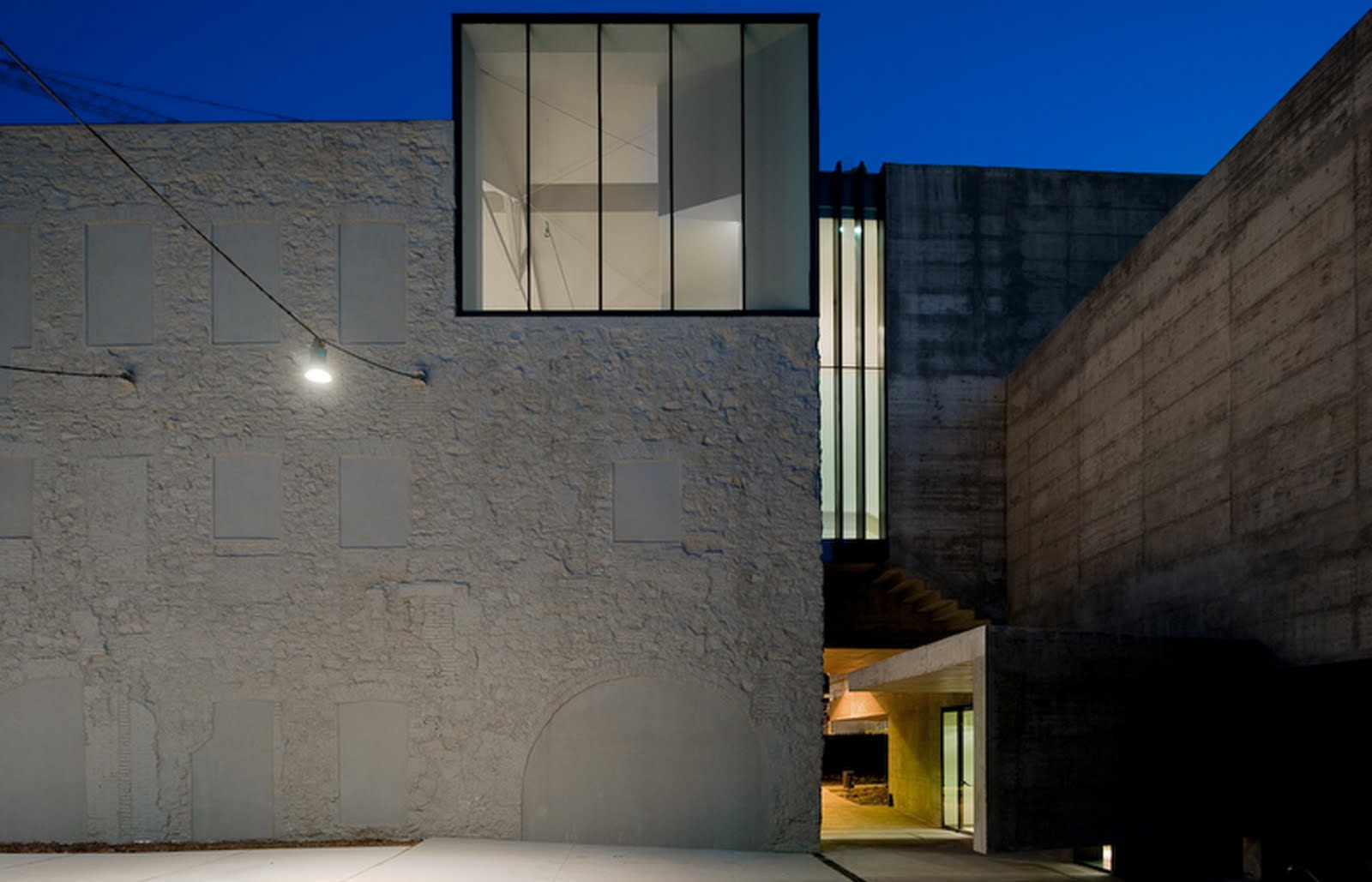
In Can Framis, 22@District, Poble Nou, Barcelona, a new museum sits among a high-rise, heavily built-up housing and hi-tech industrial area. This former factory industrial zone is a recent redevelopment project by the City Council. The Architects play on contrasts, with a surrounding garden of trees and winding paths providing tranquillity from the busy site. Jordi Badia has preserved two derelict building with little architectural interests. Restoring the two current factory buildings and constructing a new one which will link them, also integrating with the site of another warehouse will form a courtyard that serves as the main museum entrance. Visitors will begin on the highest level and walk downwards through its semi-lit areas before standing up to showpiece, the exhibited pieces. The Architects have used wood on window frames, staircases and between the buildings and the painting support screens as a reference to the material used for canvas frames. Lime mortar, stonework and concrete is used externally thus creating a collage of textures that reflect the historic use of the building.
Friday, 23 April 2010
tuber melanosporum


I especially love truffles, both black and white. Delicious! Ensamble Estudio has created 'The Truffle' on Costa da Morte, Spain made from earth and minerals thus emulating and integrating the natural environment. This experiment made from a hole in the ground, piling up with topsoil, building a volume with hay bales and flooded the negative space between the earth and the built air to solidify it. As time passed, the earth is removed and the 'truffle' is discovered.The Architects then made a few quarry cuts to open up its core. A calf by the name of Paulina enjoyed the delicious hay as she nourished it for a whole year. Not only the 'truffle' was her pantry, it was also her habitat. A year on, the now adult Paulina leaves and a new interior volume appears for the first time. The dense materiality contrasts the fluidity of the ceiling that sublimely evokes a sense of the Atlantic Ocean nearby.
Subscribe to:
Comments (Atom)